Cooktop Repair in Orange County
Three quite different machines share the word cooktop. Gas is mechanical and largely serviceable. Radiant electric is simple and mostly a matter of elements and switches. Induction is power electronics under glass, and it protects itself with error codes that are worth reading properly before anything gets replaced.
Gas cooktops: ignition and flame
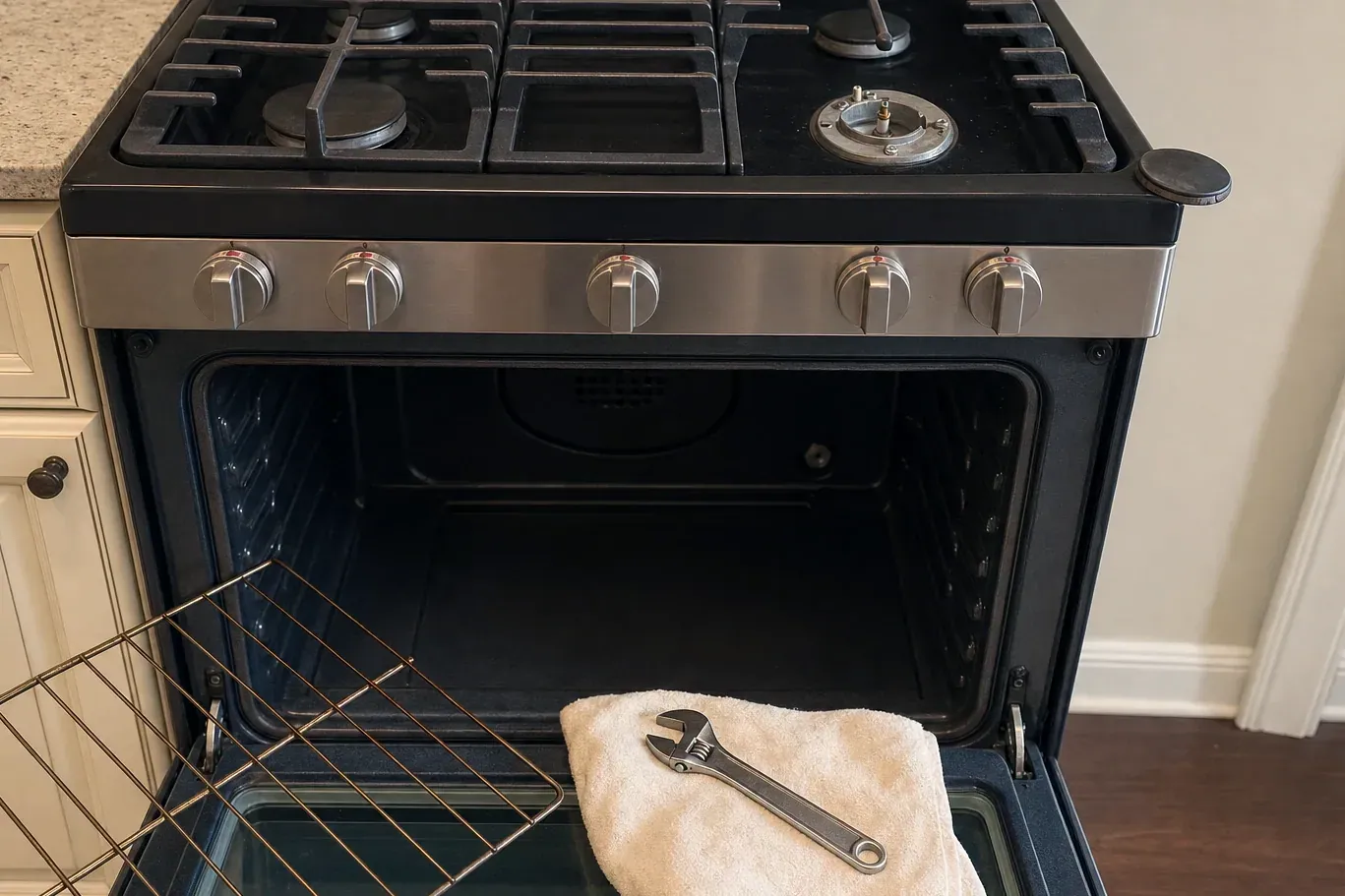
When every burner clicks at once, that is the spark module firing all electrodes, which is normal on some designs and a fault on others; a burner cap left wet or sitting slightly off its ring will cause it. When one burner clicks and never lights, look at that electrode and its ceramic for cracks and carbon, then at the cap alignment and the port holes. A burner that lights and then dies as you release the knob is the flame failure device, either a dirty thermocouple tip or a valve no longer holding. Yellow, lifting flames usually mean the ports or the orifice need cleaning.
Radiant and coil electric cooktops
One dead zone with everything else working is a simple circuit to follow: the element, the infinite switch that feeds it, and the connections at both. Elements fail open and are visibly discoloured or parted at the failure point. A zone stuck on full heat regardless of the knob is the infinite switch welded closed, and that one matters, because a burner that cannot be turned down is a hazard rather than an inconvenience. Isolate at the breaker until it is repaired. Cracked ceramic glass is not a repair; the glass is a replacement part and on many models a costly one.
Symptoms we are called about
- one burner dead, the rest fine
- igniter clicking without lighting
- induction zone reports an error code
- burner will not come off full power
- glass surface cracked around a zone
What usually fails, and how you tell
| Fault | How it shows | What the repair involves |
|---|---|---|
| Spark module or shorted electrode | Continuous clicking, often on every burner at once, sometimes even with all knobs off. A cracked electrode ceramic or a carbon track is usually visible at one burner. | Clean and dry the burner area first, then replace the failed electrode or the module. Wet caps cause a surprising share of these calls. |
| Misaligned or blocked burner cap | One burner clicks but will not light, or lights with a lopsided, lifting flame. The cap does not sit flat, or the ports are blocked with cooked-on spill. | Clean the ports and the cap, clear the orifice, and reseat it square. No parts needed on most of these, and it is checked before anything is ordered. |
| Flame failure device | The burner lights while the knob is held in and goes out as soon as it is released. Every other burner behaves normally. | Clean the thermocouple tip and check its position in the flame, then replace the thermocouple or the valve if it still will not hold. |
| Open radiant element | One zone stays cold while the others work. The element often shows a visible break or a discoloured section, and it reads open-circuit. | Replace the element and inspect the terminals, since a burnt connection at the element will take the new one out as well. |
| Infinite switch welded closed | A zone that comes on at full power the moment the hob is powered, or will not come down from full regardless of the knob position. | Isolate the hob at the breaker and replace the switch. This is a safety fault, not something to keep using until it is convenient. |
| Induction over-temperature trip | A zone runs for a few minutes and then shuts down with an error code, and it recovers after cooling. The cooling fan is often silent or audibly obstructed. | Clear the fan path, confirm the ventilation clearance under the counter, and replace the fan or the power board where it has genuinely failed. |
| Cracked ceramic glass | A visible crack radiating from a zone or an impact point. On induction and gas-on-glass models the hob may refuse to run at all. | The glass is a replacement part, not a repair, and it is model-specific. On an older hob this is usually the point where replacement is the honest answer. |
Induction: codes, fans and coils
Induction hobs are driven by power electronics that run hot and are cooled by a fan under the glass. Most error codes report the electronics protecting themselves: an over-temperature trip because the fan is blocked or has failed, or because the appliance is boxed in with no ventilation under the counter. A zone that works for a few minutes and then drops out is the classic pattern. Genuine coil failures happen but are much rarer than board and fan faults. Codes should be read against the model documentation, because the same number means different things across makers.
Touch controls and cracked glass
Touch controls on both radiant and induction hobs sit under the glass and are affected by moisture, spilled liquid and heat. A control that responds erratically or locks itself is usually reporting a wet surface or a failing control board rather than a broken user panel. Dry the surface fully and retest before condemning anything. Cracked glass is the honest exception on this page: it cannot be repaired, the replacement panel is model-specific, and on an older hob its cost frequently exceeds what the appliance is worth. A cracked induction or gas-on-glass surface should not be used.
Cooktop by town
- Cooktop in Huntington BeachBeach Cities
- Cooktop in Laguna NiguelSouth County
- Cooktop in AnaheimNorth County
- Cooktop in Mission ViejoSouth County
- Cooktop in IrvineCentral County
- Cooktop in Newport BeachBeach Cities
- Cooktop in TustinCentral County
- Cooktop in FullertonNorth County
- Cooktop in Lake ForestSouth County
- Cooktop in Santa AnaCentral County
- Cooktop in Costa MesaCentral County
- Cooktop in PlacentiaNorth County