Oven Repair in Orange County
Most oven complaints come down to one of three things: it does not get hot, it does not stay at the temperature it claims, or it has stopped with a code. Those are different subsystems, and they need different tests. Wall ovens and range ovens share almost all of this, apart from how much work it takes to get the unit out.
An oven that will not heat at all
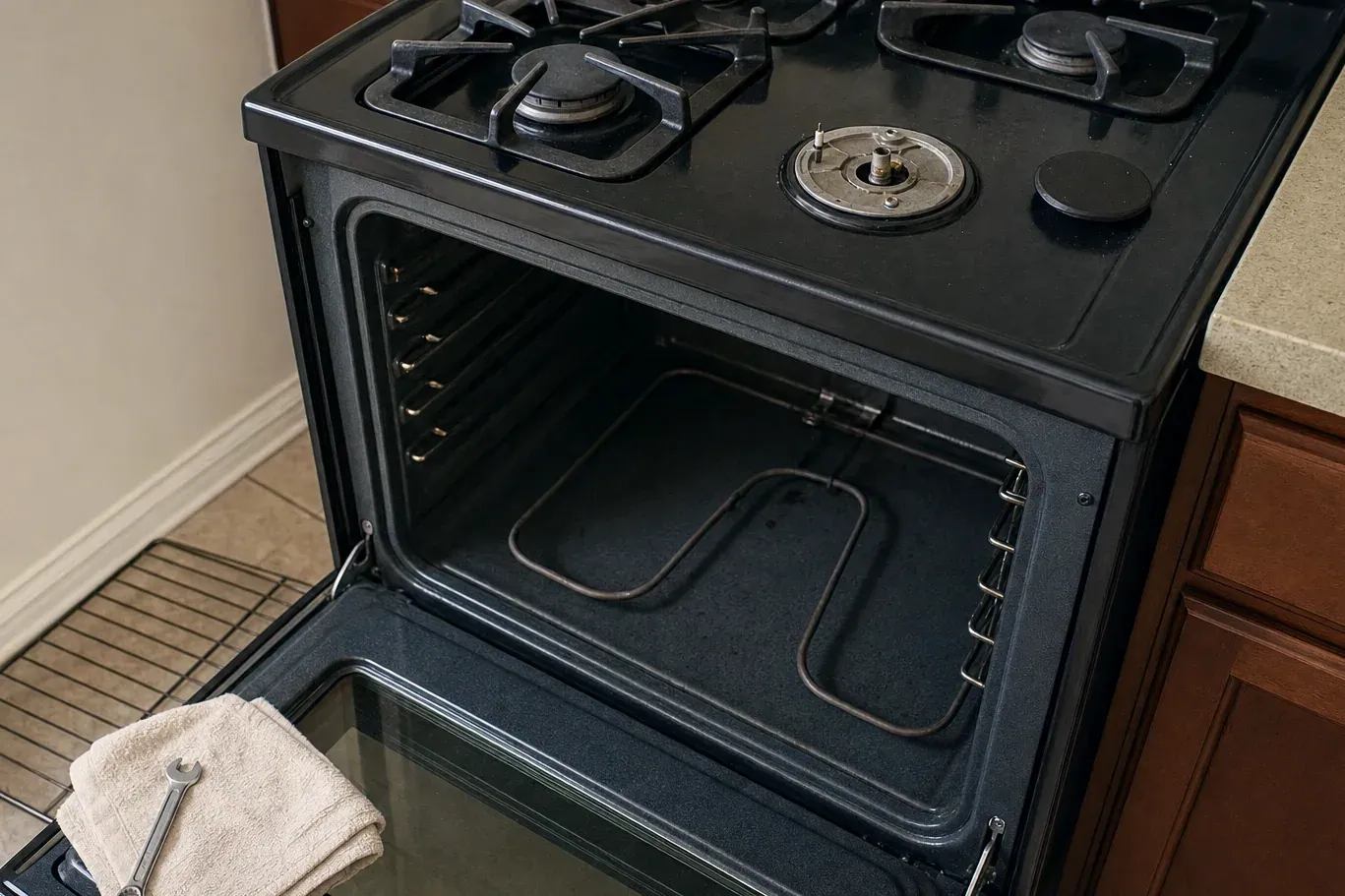
On an electric oven, look at the bake element first. A failed element is often visibly blistered or parted, and it reads open-circuit; the grill element usually still works, which is why people describe the oven as half dead. On a gas oven, the igniter and the safety valve sit in series: the valve stays shut until the glow-bar draws its rated amperage, and an aged bar can glow bright orange while drawing well under it. This is the single most misdiagnosed oven fault, because the visible glow makes the igniter look healthy. It is measured, not judged by eye.
Temperature that drifts or never arrives
An oven that browns unevenly or runs consistently cold is normally reporting the wrong temperature to itself. The sensor is a resistance probe, and as it ages its readings drift, so the board holds the cavity at the wrong target. It is a cheap part and a quick measurement against a chart. Before replacing it, the door seal and hinges get checked, because a door that no longer pulls square leaks heat continuously and produces the same complaint. Many ovens also allow a calibration offset, which is worth setting once the hardware is known good.
Symptoms we are called about
- runs fifty degrees under the set point
- bake element will not glow
- fault code on the display
- door hinge dropped and the seal is open
- self-clean cycle left it dead
What usually fails, and how you tell
| Fault | How it shows | What the repair involves |
|---|---|---|
| Open-circuit bake element | No glow from the lower element, the grill still works, and the oven takes forever or never reaches temperature. Often a visible blister or a parted section on the element itself. | Replace the element and check the terminal block behind it, since a burnt terminal will destroy the new element as well. |
| Weak glow-bar igniter | On a gas oven, the igniter glows but the gas never lights, or lights after a very long delay with a puff. The glow is bright enough to look perfectly normal. | Measure the current the igniter draws while it glows and replace it when it falls below the maker specification. Judging it by brightness is how this fault gets missed. |
| Drifted temperature sensor | The oven holds a steady temperature well away from the set point, or bakes unevenly at every setting. It heats normally, it just stops at the wrong number. | Measure the sensor resistance cold and compare it against the chart for that model, then replace it. Set the calibration offset afterwards if the model allows one. |
| Failed door seal or dropped hinge | Heat visibly escaping at the top of the door, a door that no longer sits flush, and long preheat times. The oven itself is working correctly. | Replace the gasket and reset or replace the hinges. A hinge that has lost its spring will not hold a new gasket against the frame. |
| Blown thermal fuse after self-clean | Completely dead oven, usually within a day of running the self-clean cycle. No display, or a display with no response from any function. | Replace the fuse and then find why it opened, normally a blocked cooling path or a cooling fan that has stopped. A fuse alone is not a repair. |
| Control board relay failure | One function will not run while others do, an element that stays on regardless of setting, or a code naming a relay. Sometimes a scorch mark on the board is visible. | Confirm the fault with measurements before ordering, then replace the board. This is the part most often replaced unnecessarily on an oven. |
| Convection fan or its element | Convection settings underperform while conventional bake is fine, or there is a rattle and a scrape from the back of the cavity while the fan runs. | Replace the fan motor or the ring element, and check the fan blade has not fouled its shroud after a rack was pushed too far back. |
Fault codes and control boards
A code is a starting point, not a diagnosis. Most oven codes report a sensor out of range, a door lock that will not confirm, or a relay that did not do what the board asked. Sensor and lock codes are usually the part they name. Relay codes are the board itself, and a board is the most expensive part in an oven, so it gets confirmed by measurement rather than assumed. Boards also fail from heat, which is why a control that sits directly above the cavity on a wall oven fails more often than one in a range.
Self-clean, and what it costs you
The self-clean cycle takes the cavity far above normal cooking temperature for hours, and it is the most common cause of an oven that was working in the evening and is dead the next morning. The usual casualty is a thermal fuse, which does its job and cuts power. Door lock motors, sensors and control boards are the next most common. If you use self-clean, run it with the kitchen ventilated and not the night before you need the oven. In many of the units we see, a manual clean is the safer option on older equipment.
Oven by town
- Oven in Huntington BeachBeach Cities
- Oven in Laguna NiguelSouth County
- Oven in AnaheimNorth County
- Oven in Mission ViejoSouth County
- Oven in IrvineCentral County
- Oven in Newport BeachBeach Cities
- Oven in TustinCentral County
- Oven in FullertonNorth County
- Oven in Lake ForestSouth County
- Oven in Santa AnaCentral County
- Oven in Costa MesaCentral County
- Oven in PlacentiaNorth County