Wine Cooler Repair in Orange County
Wine cabinets are asked to hold a narrow band of temperature and humidity behind a glass door, which is the worst insulator in the kitchen. Most of the faults we see are not refrigeration failures at all. They are airflow, seals and sensors, and they get blamed on the compressor because the symptom looks identical from the outside.
Undercounter, freestanding and column cabinets
An undercounter cabinet breathes through a narrow front grille, so anything that restricts it, dust, a kick panel refitted the wrong way round, a cabinet built tight to the sides, shows up as a unit that runs without ever reaching set point. Freestanding cabinets vent at the back and usually fail on the seal or the fan instead. Column and full-height storage units carry two evaporators and more sensors, which means more things that can drift and a diagnosis that starts with readings rather than parts. The first question on any of them is always where the heat is meant to go.
Compressor cabinets and thermoelectric cabinets
Two very different machines get sold under the same name. A compressor cabinet is a small refrigerator: it cycles, it hums, and it can usually hold a low set point in a warm room. A thermoelectric cabinet uses solid-state modules and a fan, runs almost silently, and can only pull the cabinet a fixed number of degrees below the room. A thermoelectric unit in a garage in an inland Orange County summer will never reach set point, and no part will change that. Knowing which one is in front of you rules out half the possible faults immediately.
Symptoms we are called about
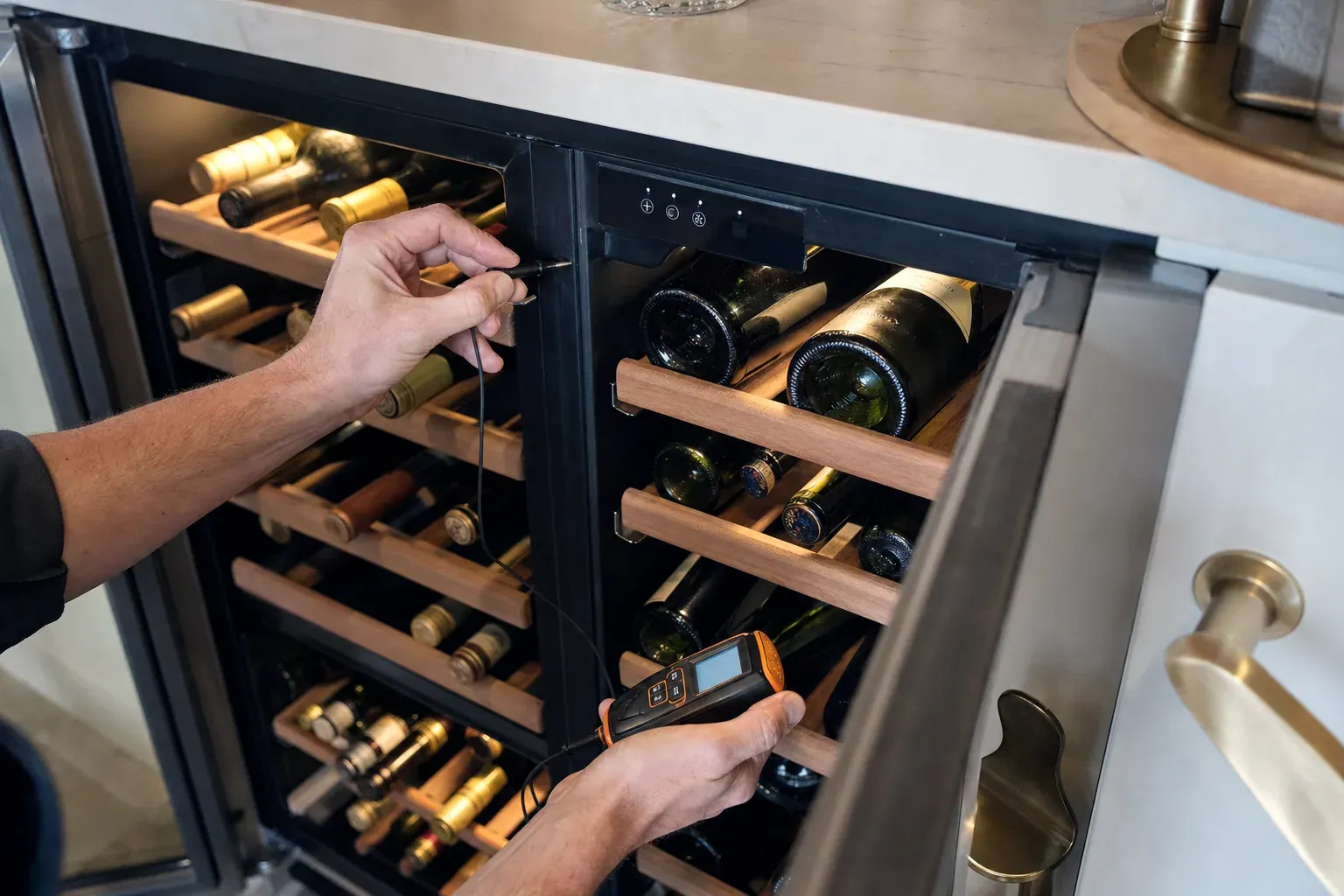
- cabinet sits ten degrees above the set point
- compressor runs without ever cycling off
- condensation on the inside of the glass
- one zone cold, the other warm
- door seal no longer pulling shut
What usually fails, and how you tell
| Fault | How it shows | What the repair involves |
|---|---|---|
| Blocked condenser or restricted grille | The cabinet sits well above set point, the compressor never cycles off, and the grille area or the back of the unit is noticeably hot. Common in undercounter installs where the surround is tight. | Clear and comb the condenser, restore the clearance the maker specifies, and check the kick panel is fitted the right way round. This is the single most common wine cooler call we take. |
| Condenser or evaporator fan motor | A cabinet that cools slowly with the compressor running, or cools at the top and not the bottom. Often there is a bearing rattle first, then silence from the fan while the compressor stays audible. | Replace the fan motor and clear whatever fouled it. On dual-zone cabinets check both fans, since only one may have failed. |
| Door gasket set or dropped hinge | Condensation on the inside of the glass, frost at one corner of the cabinet, and a compressor that runs almost continuously. A strip of paper pulls out freely at the point where the seal has gone. | Replace the gasket and reset the hinge or the levelling feet, because a gasket fitted to a door that no longer sits square will fail the same way. |
| Thermistor drift | The display and the actual cabinet temperature disagree by several degrees, and the unit either runs constantly or cycles far too early. Cooling itself is clearly working. | Read the sensor against a known thermometer and replace it. This is often mistaken for a failing compressor and it is not the same job. |
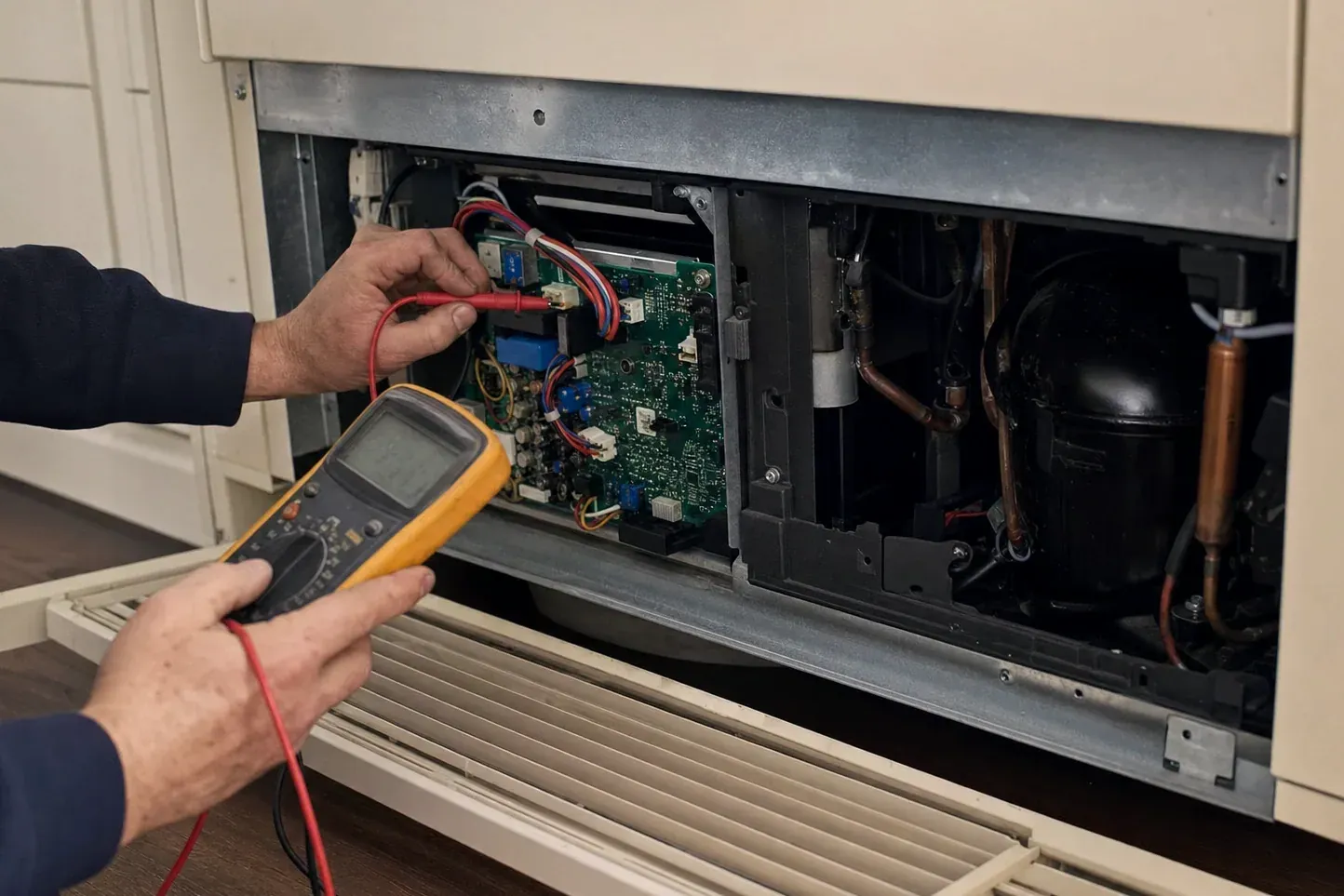
| Compressor start relay or overload | A click every few minutes, no cooling, and a compressor that is warm but not running. Sometimes it starts on the third or fourth attempt and then holds until the next off cycle. | Test and replace the start device, then confirm the compressor draws normal current. A relay is a small part, and it is worth ruling out before anyone writes the cabinet off. |
| Thermoelectric module failure | On a silent, fan-only cabinet, the interior sits a few degrees under room temperature and goes no further, whatever the set point says. No compressor noise has ever been part of this unit. | Replace the module and its heatsink paste, and clear the fan path. Where the room itself is hot, explain the limit rather than fitting parts that cannot beat it. |
Condensation, humidity and the door
Water on the inside of the glass is usually not a refrigeration fault. It is warm humid air getting in, either past a gasket that has taken a set, or through a door that no longer pulls square because the hinge has dropped or the cabinet is out of level. Reversible doors that have been swapped are a common culprit, as are shelves loaded past the point where the door can close fully. Check the seal with a strip of paper all the way round before anyone talks about refrigerant, because a leaking seal also explains a compressor that never stops.
Set-point drift and dual-zone cabinets
A cabinet reading ten degrees off is not always cooling badly. Thermistors drift with age, and a sensor reporting the wrong number makes the board run the compressor to the wrong target. That is a cheap part and a quick test. Where one zone is cold and the other is warm, look at the damper, the zone fan and the second sensor before the sealed system, because a compressor that can cool one zone is working. If both zones are warm together and the compressor is hot and running, the fault moves back to airflow or the sealed system.
Wine Cooler by town
- Wine Cooler in Huntington BeachBeach Cities
- Wine Cooler in Laguna NiguelSouth County
- Wine Cooler in AnaheimNorth County
- Wine Cooler in Mission ViejoSouth County
- Wine Cooler in IrvineCentral County
- Wine Cooler in Newport BeachBeach Cities
- Wine Cooler in TustinCentral County
- Wine Cooler in FullertonNorth County
- Wine Cooler in Lake ForestSouth County
- Wine Cooler in Santa AnaCentral County
- Wine Cooler in Costa MesaCentral County
- Wine Cooler in PlacentiaNorth County