Refrigerator Not Cooling: A Troubleshooting Guide
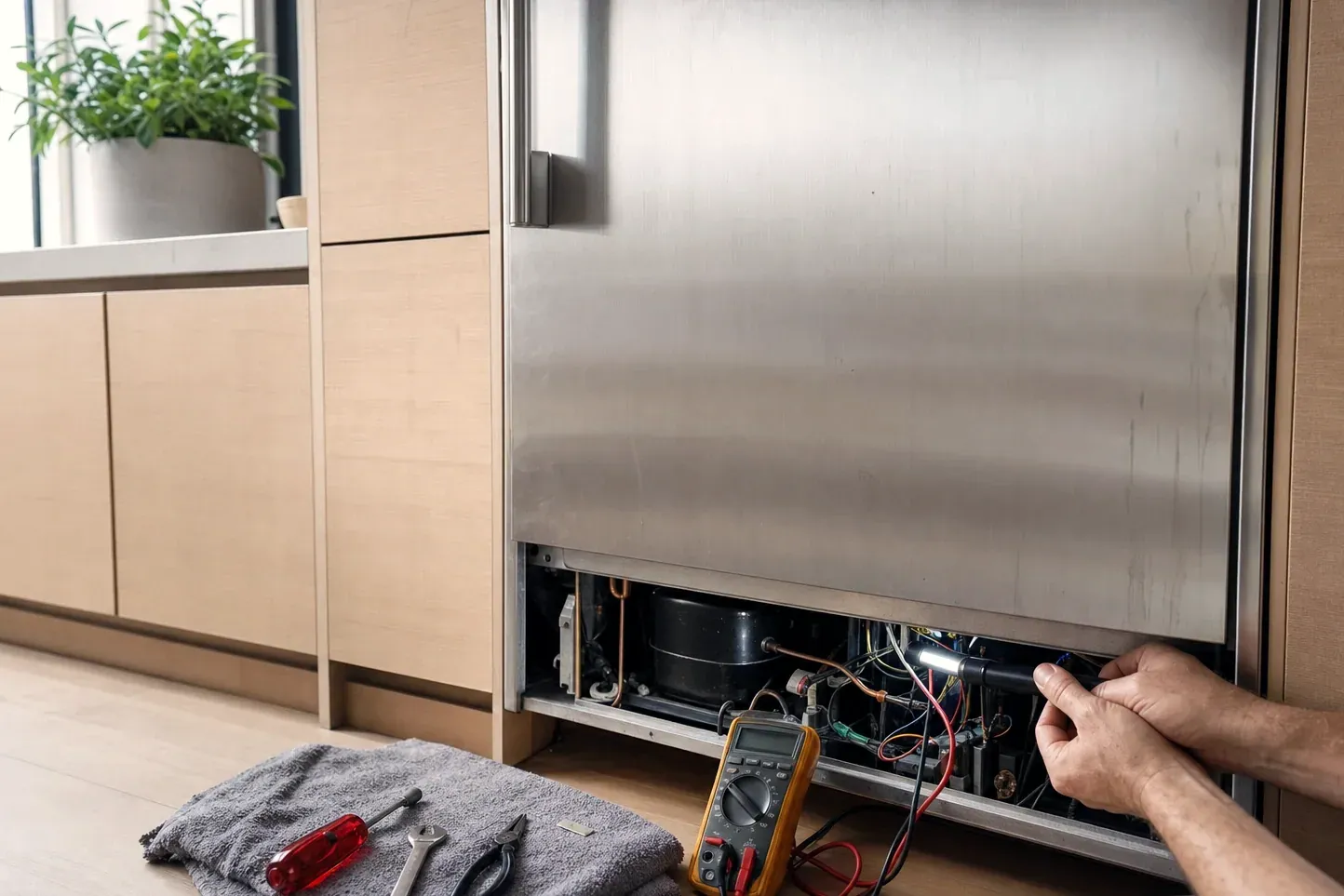
A refrigerator that has stopped cooling is rarely a single failure. In most of the units we see, cold is still being made somewhere and simply is not reaching the food. The order in which you check things matters, because two of the most common causes are free to rule out and the rest are not. This guide follows the sequence a technician would use.
Work out which compartment is actually warm
Before touching anything, put a thermometer in a glass of water in each compartment — fresh food and freezer — and leave both for a couple of hours. What you learn decides everything after it.
If the freezer is cold and the fresh food section is warm, cold is being made but not moved, which points to airflow, a damper or a fan rather than the sealed system. That is the most common version of this fault by a wide margin.
If both compartments are warm, cold is not being made at all, and the list narrows to the condenser, the compressor or the sealed system.
If both are colder than they should be, you are looking at a control or thermistor fault, not a cooling failure.
Check the airflow inside before anything else
Vents inside a refrigerator are small and easy to bury. In the fresh food section the supply vent is usually at the top rear or in a side wall; in the freezer it sits behind the back panel. A box pushed against either one will warm a compartment by several degrees within a day.
Take everything off the top shelf and away from the back wall, and check that nothing has slid across a vent. Overfilling does the same thing: a packed cabinet leaves no room for air to circulate, and the shelf furthest from the vent warms first.
Give it a full day after clearing the vents before deciding whether anything changed. Recovery from warm is slow, and judging it after an hour leads people to the wrong conclusion.
Clean the condenser coil, then listen for its fan
The condenser coil sheds the heat the system removes from inside. When it is furred with dust and pet hair it cannot, and the whole cabinet drifts warm while the compressor runs constantly.
On most freestanding units the coil sits behind a snap-off grille at the bottom front, or against the back panel. Unplug the machine, take the grille off, and vacuum the coil with a brush attachment, working along the fins rather than across them.
While the grille is off, look at the condenser fan. It should be clean and turn freely by hand. A blade jammed by a mat of dust, or a motor that has seized, produces exactly the same symptom as a dirty coil, and the symptom will return within days of a clean if the fan is the real problem.
Frost sheeting the back wall means the defrost system
A thin, even frost on freezer contents is normal. A solid sheet of ice across the back panel of the freezer is not, and it is one of the clearest diagnoses in this trade.
Behind that panel is the evaporator coil, and it ices up as part of normal operation. Three components clear it on a cycle: a defrost heater, a bimetal or thermostat that allows the heater to run, and the control that calls for the cycle. When one fails, ice builds until it blocks the airflow path completely, and the fresh food section warms while the freezer still reads cold.
You can confirm it by defrosting manually. Empty the unit, unplug it, and leave the doors open overnight. If cooling returns for a few days and then fails the same way, the defrost circuit is the fault.
A silent freezer usually means the evaporator fan
Open the freezer and hold the door switch in with a finger. On most units the evaporator fan should run, and you should be able to hear it. If the compartment is silent, the fan is either not being asked to run or cannot run.
A fan that has iced over usually rattles or chirps for a while before it stops. One with a failed motor makes no sound at all. Either way the result is characteristic: the freezer holds temperature reasonably well because it sits next to the coil, while the fresh food section slides warm because nothing is pushing air into it.
Replacing the fan means taking the back panel out of the freezer, and on many built-in models that panel is foam-bonded. That is a technician job.
Door seals, and the degrees you never get back
A gasket that no longer pulls shut costs a few degrees continuously and makes every other fault look worse than it is. Trap a sheet of paper in the closed door and pull: it should drag. Repeat at four or five points along each door, especially the hinge side and the bottom corner, which are the first areas to go.
Seals usually go hard rather than tearing, and warm humid air leaking past one shows up as condensation inside the cabinet and a compressor that never cycles off.
Washing the gasket in warm soapy water and drying it will sometimes restore enough flexibility to test the theory. If a corner has curled permanently, the gasket is a part rather than a repair.
Where it stops being a homeowner job
Everything above is airflow, cleaning and observation. Past that point the work involves either mains voltage or the sealed refrigeration system, and neither is a homeowner job.
The sealed system (compressor, condenser, capillary and evaporator) is a closed circuit under pressure. Opening it needs recovery equipment, licensed handling of refrigerant, brazing, and a proper vacuum before recharge. There is no version of that done safely with hand tools, and a system opened and closed badly fails again quickly.
Control boards, compressor start relays and inverter boards carry mains voltage and can hold charge after the plug is pulled. If your diagnosis has arrived at the compressor, the sealed system or the main board, stop there and have it tested with the right equipment.
What to do with the food while you wait
A closed refrigerator holds usable temperature for roughly four hours, a full freezer for about two days, and a half-full one for about half of that, provided the doors stay shut. Opening them to check resets that clock, so decide once and then leave it alone.
If the freezer is the compartment that failed, move what you can into a cooler with ice or a neighbour’s freezer. Refrozen food is a food-safety question rather than a quality one, so when in doubt, discard.
If only the fresh food section is warm, milk, meat and prepared food come out first.
Leave the appliance running unless it is tripping a breaker or the compressor is audibly labouring. A unit cooling badly is still cooling, and switching it off to rest it repairs nothing.
What you can check yourself
- Put a thermometer in a glass of water in each compartment and read both after two hours.
- Check that no box, bag or takeaway container is sitting against an interior vent.
- Confirm the temperature settings have not been knocked, and that any demo or showroom mode is switched off.
- Unplug the unit and vacuum the condenser coil behind the bottom grille or the rear panel.
- Look for a solid sheet of ice across the back wall of the freezer.
- Hold the freezer door switch in and listen for the evaporator fan.
- Test each door seal with a sheet of paper at several points along its length.
- Check the plug is seated fully and that the outlet has not tripped.
Questions
- How long should it take to cool down after I clear the vents or the coil?
- Give it a full day. A refrigerator that has been warm has warm food and warm walls in it, and pulling all of that back down takes far longer than the original cool-down from empty. Judging the result after an hour or two usually leads to the wrong conclusion.
- Is frost on the back wall of the freezer normal?
- A light, even frost on food is normal. A solid sheet of ice across the rear panel is not. That panel covers the evaporator coil, and ice building across it means the defrost cycle is no longer clearing it, which is a heater, thermostat or control fault.
- The freezer is cold but the fridge is warm. What causes that?
- Almost always airflow. The cold air for the fresh food section is made in the freezer and moved across by a fan through a duct. A stalled evaporator fan, an iced-over duct or a stuck damper produces exactly this split, and all three are common.
- Should I unplug the refrigerator while I wait for a repair?
- Usually not. A unit cooling badly is still cooling, and switching it off rests nothing. Unplug it if it is tripping the breaker, if there is a burning smell, or if you have been asked to defrost it manually as part of the diagnosis.
- Is a failed compressor worth replacing?
- Sometimes, depending on the age and the type of machine. It is a long job needing refrigerant recovery and recharge, so on an older freestanding unit it usually is not worth doing, while on a younger built-in it often is. It is never a homeowner repair.